

Search Engine Optimization (SEO) is a complex topic that involves every aspect of your site. If your website and web pages are going to be successful, you need to be selecting keywords for SEO.
For many of my clients, organic search traffic accounts for a large portion of the overall traffic to their website. This type of traffic is important because it can indicate that visitors are, at some point, in the buying process. In my personal experience, websites with the highest and best SERP ranking tend to be the most trafficked. Makes sense, right? Websites with higher rankings are generally the most relevant to the words/phrases that were typed into the search box. That said, a crucial step in the SEO journey is to perform keyword research to determine which keywords to optimize for, and that would have the greatest potential for visibility on SERPs.
Keyword research is an intricate process, and is not an exact science. However, if done correctly, it can provide some of the highest returns out of any SEO activity.
Here are some of the best practices that you can follow when it comes to conducting keyword research:
Identifying Long Tail Keywords
Long tail keywords are specific, or targeted, search phrases that visitors are likely to use as they get further along in the buying process. Selecting keywords for SEO means specifying your keyword research to target low-volume, but highly targeted keywords and phrases. As a small business, you have a specialized niche that caters to a specific group of people. The keywords you use need to follow this same pattern! The more specific your keyword phrases are, the better chance you’ll have at ranking higher in SERPs.
Long tail keywords will always have lower traffic volumes than generic keywords, but your chances of gaining traffic, interactions, and sales will increase will increase because you’re interacting with a targeted audience who know what they want.
To determine what some of these long tail keywords might be for your target audience you can:
- Develop in-depth buyer personas and a CCI (Customer Composite Index)
- Use the “searches related to” section of Google
- Scroll through Google News and look for articles on a specific topic
- Start a LinkedIn group or a discussion forum where people can interact and ask questions
Essentially, knowing what areas your audience is passionate about and unsure about will give you clues as to what they might be looking for from an online search. You can also use a variety of keyword research tools like SemRush, RavenTools, or Moz’s Keyword Explorer to find keywords (and related keywords) for your topic. Remember, just because the traffic is lower for long tail keywords doesn’t make it bad.
Below is a graph created by Moz which illustrates the “Search Demand Curve”. As you can see, focusing on “long-tail” keywords gives marketers the opportunity to rank highly for 70% of the searches on the web, which may have little to no competition, to garner traffic with greater relevancy to the products and/or services offered.
Including LSI (Latent Semantic Indexing) Keywords
Remember when I mentioned that “searches related to” section in Google Search above? It plays a big role in finding LSI keywords as well.
So what are LSI keywords? LSI keywords are keywords that are related to your main keyword. For example, if you want to optimize a web page for the keyword “Batman”, you should also include keywords like “Gotham”, “Joker”, “Alfred”, “Batmobile” and so on. LSI keywords help to create depth to your content and help to establish your authority in the subject. The LSI keywords you choose demonstrates that you, as the web page author, know what you’re talking about and can add value to the conversation.
Including LSI keywords also gives search engines other possible keywords that your article may be found under during a search. This is a good thing because your webpage will have a higher chance of showing up in several SERPs. However, you do want to make sure that the main keyword or keyword phrase you optimized your article for is still getting web traffic. If not, you need to consider re-optimizing your web page!

Here’s how you can check keyword optimization effectiveness in Google Search Console:
Step 1: Log into your Google Search Console account
Step 2: On the left hand side bar, select “Search Traffic” and then “Search Analytics” from the drop down menu that appears
Step 3: Check each box for “Clicks”, “Impressions”, “CTR” and “Position” above the graph
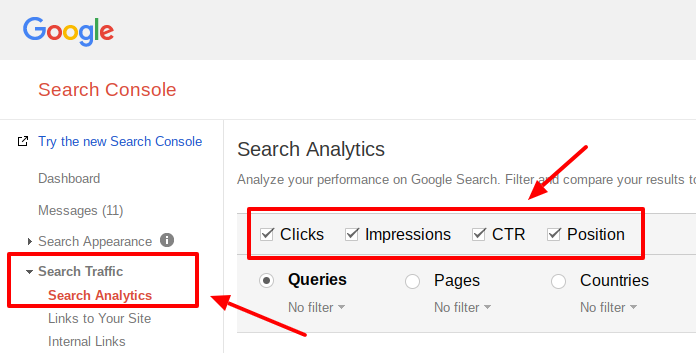
Step 4: Select “Page” and then “Filter Pages” from the drop down menu. Add the URL for any page you want to check and select the “Filter” button
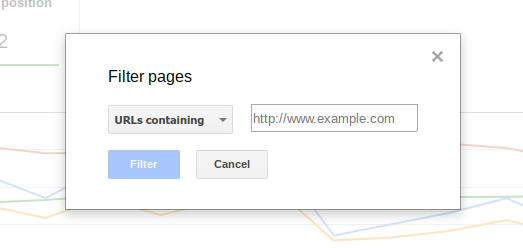
Step 5: All the keywords and their accompanying metrics used to find that page will appear in a list and graph format
Using the right keywords is what will help your pages rank higher and encourage searchers to click through your result when they see it. Selecting keywords for SEO is not a one time deal, you need to always be checking and updating your keywords to accommodate the latest search trends within your target audience.
In Conclusion
Keyword research is an involved process that requires a lot of time and effort from those performing the research, but it’s an integral part of SEO. Once keywords have been identified, each page on the website can be optimized accordingly. This isn’t a “one-and-done” process either. Search Engine Optimization is something that should constantly be reviewed, especially as shifts occur within a client’s industry.
 Blog
Blog Case Studies
 Infographics
 Free Comprehensive Analysis